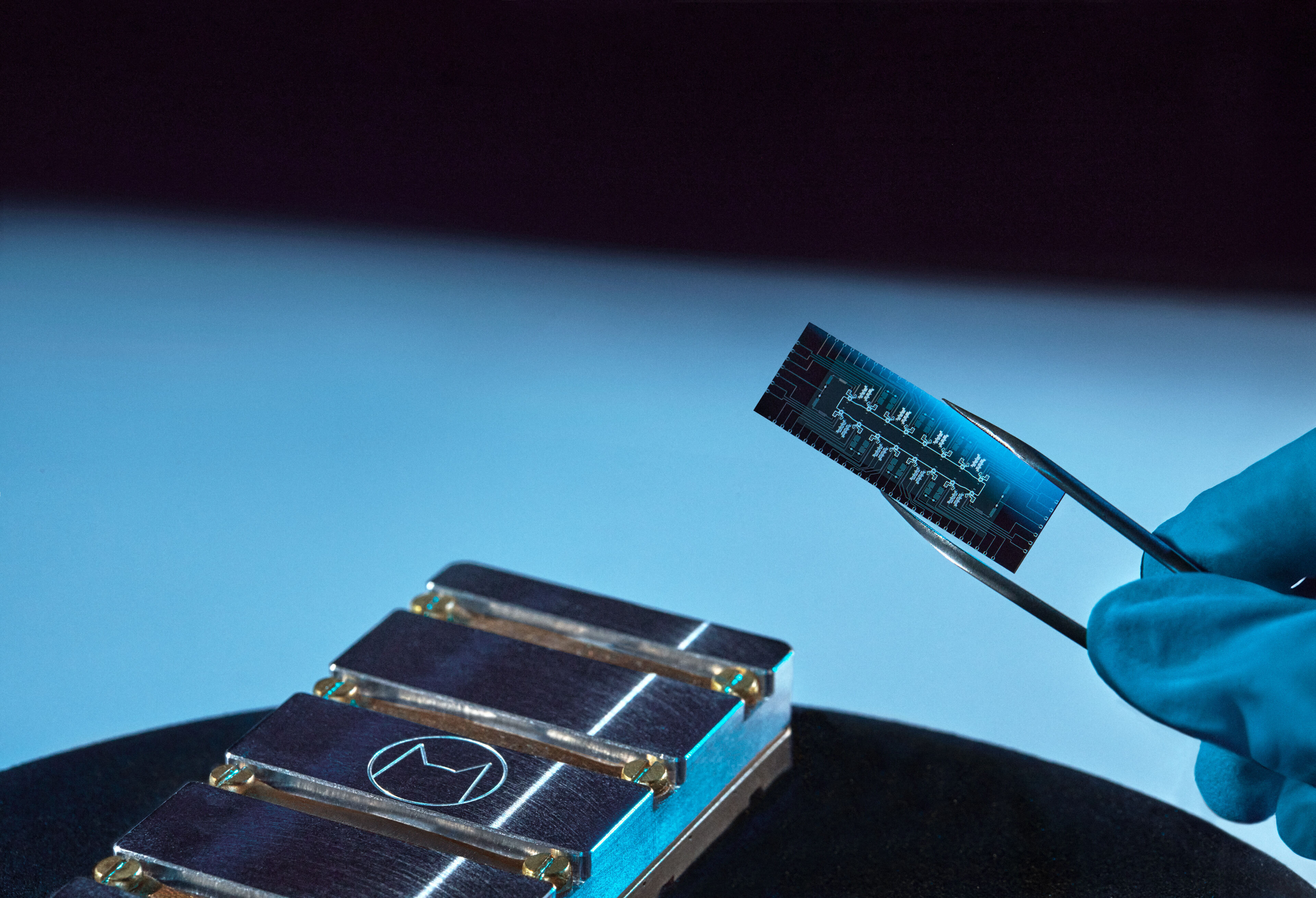
Alice & Bob develops a superconducting architecture based on cat qubits. The idea is to physically protect information against one family of errors, then correct the remaining errors using multiple qubits. The “cat” is a quantum superposition of electromagnetic-field states. [1]
1. A memory for microwave light
The carrier is an electromagnetic mode of a superconducting resonator. Its photons are microwaves, not visible light. The circuit sits at very low temperature in a cryostat to limit thermal excitations and enable superconducting operation. A nonlinear Josephson-junction element controls photon exchange. The chip, microwave lines and control electronics therefore form one experimental system. [2]
2. Opposite oscillations and their superposition
Two coherent states, |α⟩ and |−α⟩, have equal amplitudes and opposite phases. They provide an approximate qubit basis when their overlap is small. The mean photon number is n̄ = |α|². Superpositions proportional to |α⟩ + |−α⟩ and |α⟩ − |−α⟩ are even and odd cats: their photon numbers have even or odd parity. The two-lobe drawing depicts field phase space, not two separate objects on the chip. [1]
3. Stabilize by engineering photon loss
An isolated memory eventually loses its photons. In the dissipative approach, it is coupled to a second mode, the buffer, designed to release energy rapidly. An exchange converts two memory photons into one buffer photon; a coherent drive also supplies a two-photon process. Together, drive and dissipation stabilize the cat subspace. Simply removing photons in pairs would not suffice: without suitable driving, the memory would empty. [2, 3]
From microwave memory to a protected qubit
- EncodeTwo opposite coherent states
- StabilizeDrive + two-photon exchange
- DissipateLossy buffer into the environment
- CorrectMultiple cats + syndrome measurements
↶ Continuous stabilization; correction cycles for remaining errors
Selective protection: bit flips are strongly suppressed; phase errors still need correction.
4. Suppress bit flips, correct phase flips
A bit flip swaps the two basis states. In the protected regime, increasing cat size can suppress its rate exponentially. However, single-photon loss can cause a phase error; in the usual model, its rate grows with mean photon number. This strongly biased noise motivates a repetition code across multiple cats, mainly targeting phase errors. Gates and measurements must preserve that bias: physical protection does not replace all error correction. [3]
5. What has been demonstrated, and what remains
In 2024, Réglade and colleagues reported in Nature quantum control of cats with bit-flip times exceeding 10 seconds and phase-flip times exceeding 490 nanoseconds. Bit-flip protection was maintained during a phase-control operation. The 10 seconds are therefore not a perfect storage time for all quantum information. This demonstrates a physical building block; a universal fault-tolerant computer still requires a complete architecture, reliable operations and repeated error correction. [4]
Sources and further reading
- Alice & Bob — Cat Qubits (accessed 29 October 2026).
- Alice & Bob — Encoding Quantum Information in States of Light.
- Guillaud & Mirrahimi, Repetition Cat Qubits for Fault-Tolerant Quantum Computation, Physical Review X 9, 041053 (2019).
- Réglade et al., Quantum control of a cat qubit with bit-flip times exceeding ten seconds, Nature 629, 778–783 (2024).