1. Light meets a vibration
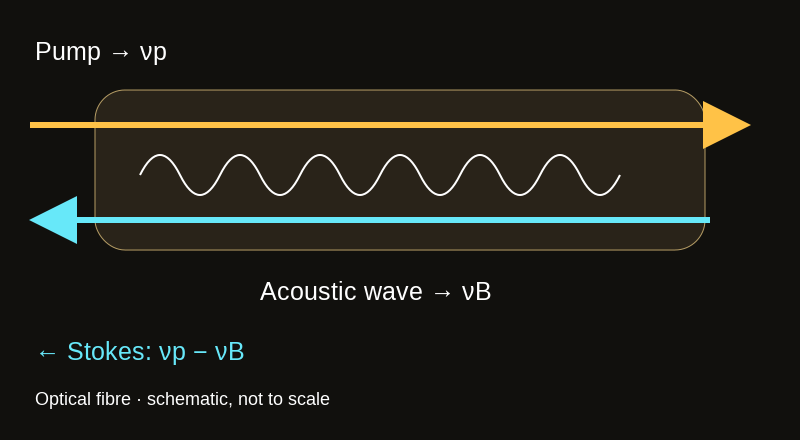
An acoustic wave creates tiny variations in density and refractive index. Light scattered by this moving modulation can exchange energy with it. In the Stokes process, the scattered photon loses energy and an acoustic phonon is created. Anti-Stokes scattering corresponds to the opposite energy exchange. [1]
2. A frequency shift, not a visible colour change
For backward scattering in a simple guided geometry, νB ≈ 2 n_eff v_a / λ₀. Here n_eff is the effective refractive index, v_a the acoustic phase velocity and λ₀ the vacuum wavelength. The Stokes frequency is νS = νP − νB. The shift depends on the medium and geometry; the two optical frequencies can still look like the same colour. [1]
3. From spontaneous to stimulated scattering
Thermal fluctuations can seed spontaneous scattering. With sufficient pump intensity and interaction length, the pump, Stokes field and acoustic wave reinforce each other. This stimulated regime provides narrowband optical gain. It is not simply ordinary reflection from a stationary mirror. [1, 2]
4. Making a Brillouin laser
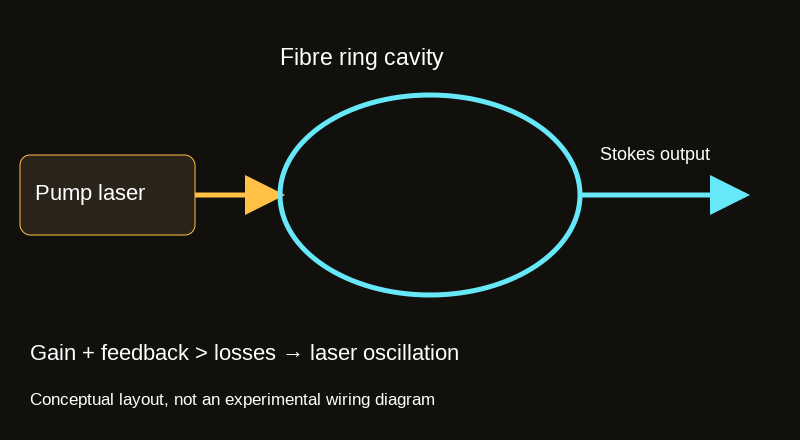
A resonator feeds the Stokes field back through the gain medium. Oscillation starts when round-trip gain compensates losses. Pump coupling, cavity modes and stability matter; low noise is an engineered result, not an automatic consequence of scattering. [2]
5. A concrete example at 532 nm
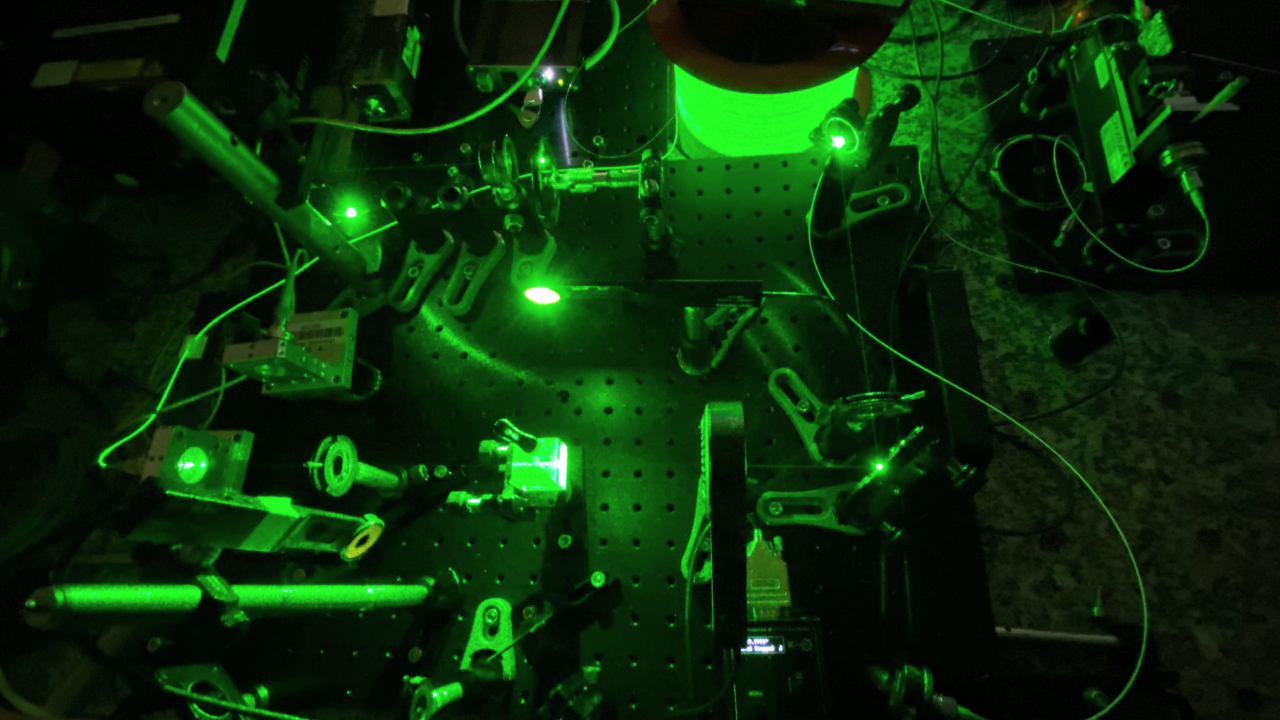
The 2025 Optics Express paper coauthored by Edgar Casta reports a visible fibre Brillouin laser with 30 mW output and an evaluated intrinsic linewidth of 6 Hz. Intrinsic linewidth describes one noise contribution; it does not mean the frequency remains within 6 Hz under all conditions or over every observation time. [3]
Sources and further reading
- Beugnot et al., Brillouin light scattering from surface acoustic waves in a subwavelength-diameter optical fibre, Nature Communications (2014).
- Behunin et al., Fundamental noise dynamics in cascaded-order Brillouin lasers (2018).
- Perin, Casta et al., Hz-level intrinsic linewidth Brillouin fiber laser in the visible range, Optics Express 33, 39751–39761 (2025). HAL ↗