As of 8 November 2026, the Clay Mathematics Institute still lists P versus NP as unsolved. The announcement examined here is OpenAI’s 26 October release: the lab reports a refutation of the Exponential Time Hypothesis (ETH), with a formalization checked in Lean. This announced result concerns a related question but does not settle P = NP. [1,2]
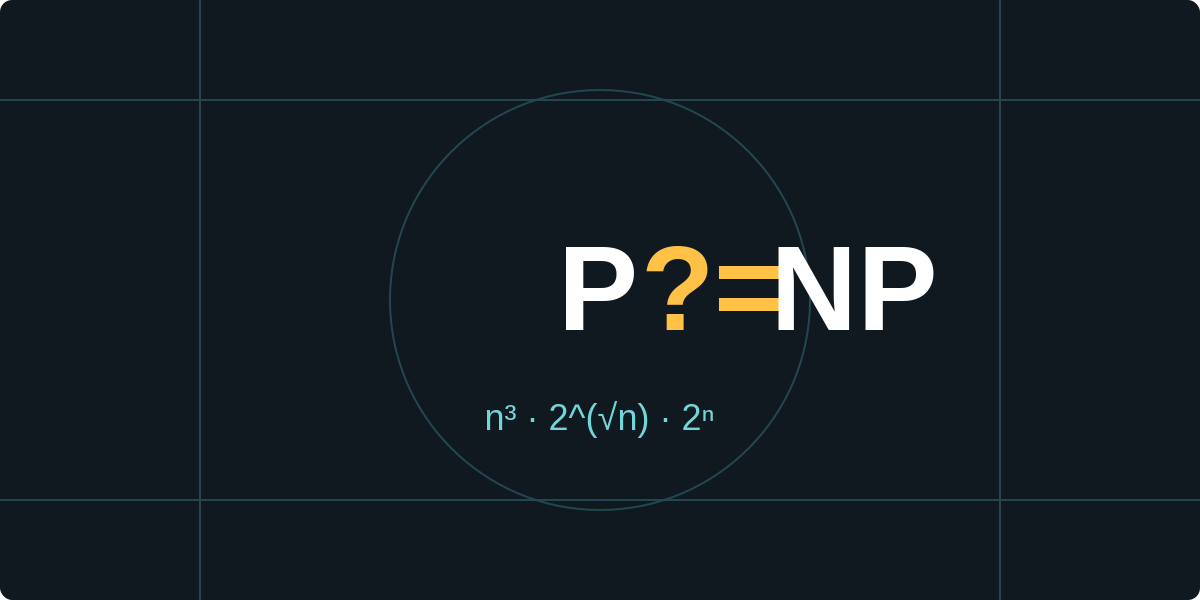
1. Finding a solution versus checking it
P contains decision problems solvable in polynomial time in the input size. In NP, a “yes” answer has a certificate checkable in polynomial time. P is known to be contained in NP; whether they are equal is unknown. NP does not mean “non-polynomial.” “Fast” is theoretical shorthand: a very high-degree polynomial can still be impractical. [1]
2. A concrete example: 3-SAT
3-SAT asks whether Boolean values can satisfy every clause, each containing at most three literals. Example: (x ∨ y ∨ z) ∧ (¬x ∨ y ∨ ¬z). Setting x = true, y = true and z = false satisfies both clauses. Checking this assignment is simple; finding one for an arbitrary formula is the challenge. Exhaustive search tries 2ⁿ assignments for n variables. A polynomial-time algorithm for every 3-SAT instance would prove P = NP. [1,3]
3. What the announcement actually says
In its usual formulation, ETH rules out solving 3-SAT in subexponential time 2^{o(n)}, up to polynomial factors. OpenAI reports a refutation produced by its system and subsequently formalized in Lean, alongside examination by external specialists. The announcement, the reported formal verification and independent assessment are distinct. This article explains their scope; it is not an audit of the proof. [2,3]
Three growth rates to distinguish
- PolynomialExample: n³. The type of bound needed to establish P = NP through 3-SAT.
- SubexponentialExample: 2^{√n}. Slower than polynomial despite improving on 2ⁿ.
- ExponentialExample: 2ⁿ. The number of assignments in exhaustive search.
ETH refuted ⇏ P = NP
For n = 100: n³ = 1,000,000; 2^{√n} = 1,024; 2ⁿ ≈ 1.27 × 10³⁰. Asymptotic ordering therefore does not guarantee numerical ordering at a given size.
4. Why this does not settle P versus NP
The time 2^{√n} is subexponential but eventually exceeds every fixed-degree polynomial nᵏ. This is an illustrative example, not the announced algorithm’s formula. Refuting ETH therefore leaves open a world where 3-SAT is subexponential but not polynomial. Conversely, a polynomial-time 3-SAT algorithm would refute ETH and establish P = NP. An improved upper bound does not prove P ≠ NP either.
5. What this could change for engineering
If the refutation is confirmed, computational limits derived solely from ETH must be reassessed: the conditional implications remain logically valid, but their assumption can no longer justify the limits. This does not automatically deliver a fast industrial solver, break all cryptography or demonstrate quantum advantage. Optimizing an optical bench or a schedule would still require a concrete algorithm, runtime measurements and tests on relevant instances.