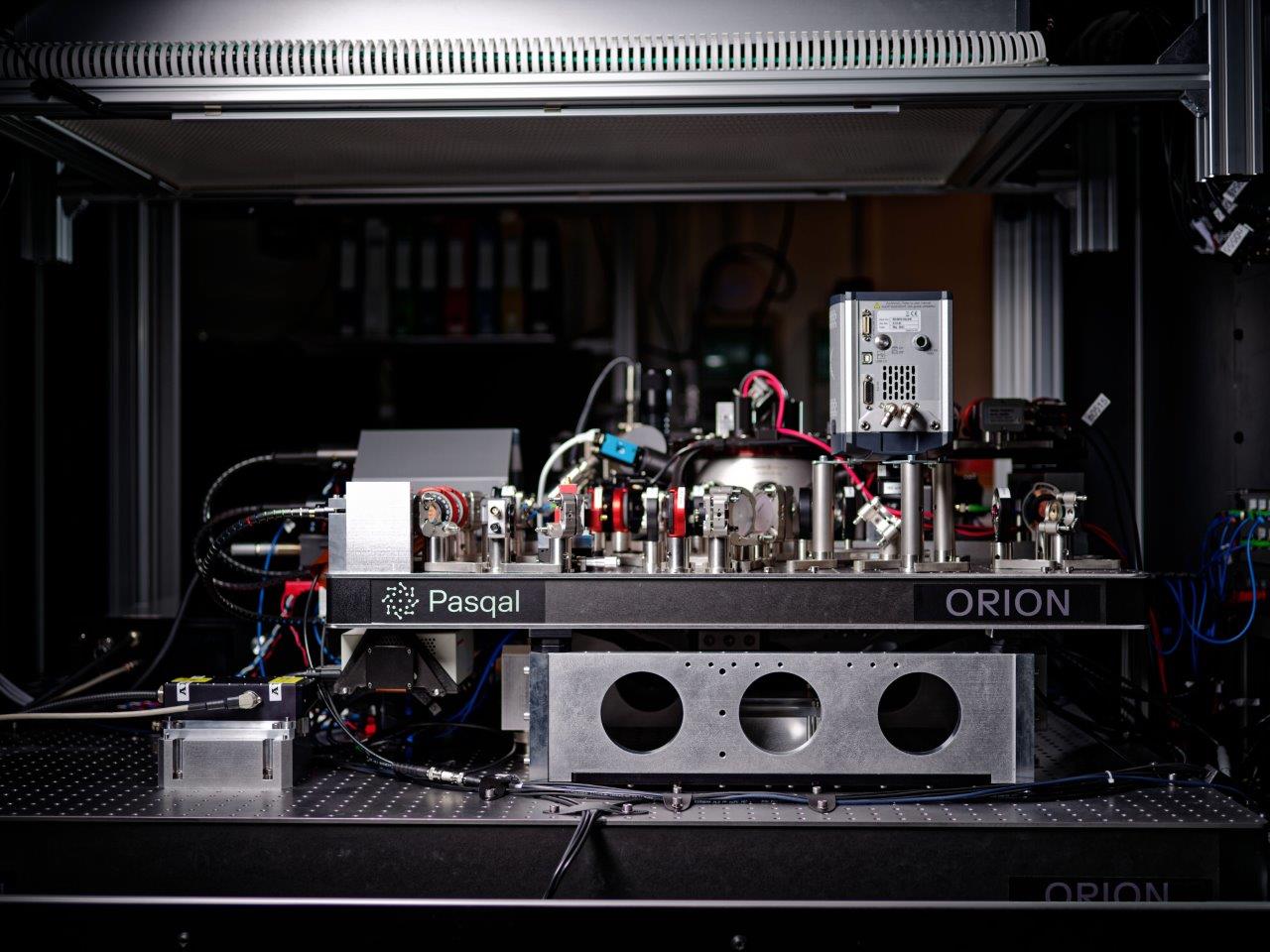
PASQAL develops processors using neutral rubidium atoms trapped and controlled by lasers. Information is carried by the atoms’ internal states; light prepares, manipulates and probes them. Here are the physical principles behind this architecture. [1]
1. Cool and trap individual atoms
Laser cooling reduces atomic motion, then tightly focused beams create optical tweezers. Their field induces an atomic dipole: in a suitable attractive trap, the intensity gradient confines the atom near the focus. Atoms are rearranged into a register with a chosen geometry. Ultrahigh vacuum limits collisions with residual gas. A room-temperature enclosure does not mean warm atoms: their motion is laser-cooled. [2]
2. A qubit is a two-level system
In Pulser’s analog Rydberg model, the two levels are a ground state |g⟩ and an excited state |r⟩. A laser pulse can prepare a superposition α|g⟩ + β|r⟩, with |α|² + |β|² = 1. Laser amplitude, frequency and phase control this evolution. In a gate-based approach, two hyperfine ground states can encode the qubit, with a Rydberg level mediating interactions. [3]
3. Rydberg blockade creates correlations
In a Rydberg state, an electron is highly excited and interactions between atoms become strong. In the van der Waals regime considered here, the interaction energy is V(R) = C₆/R⁶. For nearby atoms, the doubly excited state |rr⟩ shifts out of resonance. When |V| ≫ ℏΩ, double excitation is strongly suppressed: this is Rydberg blockade. Ω is the laser coupling’s Rabi frequency. Coherent collective excitation can then generate entanglement. The blockade radius is a useful scale, not a boundary beyond which interaction vanishes. [4]
From an atomic cloud to a result
- TrapCooled atoms + optical tweezers
- ArrangeRegister with chosen geometry
- InteractLasers + Rydberg excitation
- MeasureFluorescence + camera
↶ Repeat preparation, evolution and measurement to collect statistics
Blockade: nearby double excitation shifts out of resonance when |V| ≫ ℏΩ.
4. Program geometry and pulses
In analog computing, the register and pulses define a Hamiltonian: the system’s law of evolution. Changing distances changes interactions; changing the Rabi frequency Ω(t) and laser detuning δ(t) changes the dynamics. This enables exploration of spin models or selected optimization problems after a suitable mapping. Gate-based computing instead organizes discrete operations. Neither approach alone implies an already error-corrected universal computer. [2, 3]
5. Read an image, then repeat
Fluorescence imaging reads out the register. In the analog protocol presented by PASQAL, atoms remaining in the ground state appear bright, while Rydberg excitations are associated with dark sites at readout. Atom loss can also produce a dark signal, so preparation and detection errors must be characterized. Each run provides one sample; repeated sequences estimate probabilities and correlations. [5]