Measuring without contact
A hot surface emits thermal radiation. A pyrometer uses this signal to estimate temperature, but surface emissivity also affects the measurement. A change in surface condition can therefore alter the signal without reflecting only a temperature change. [1]
Adding reflectometry
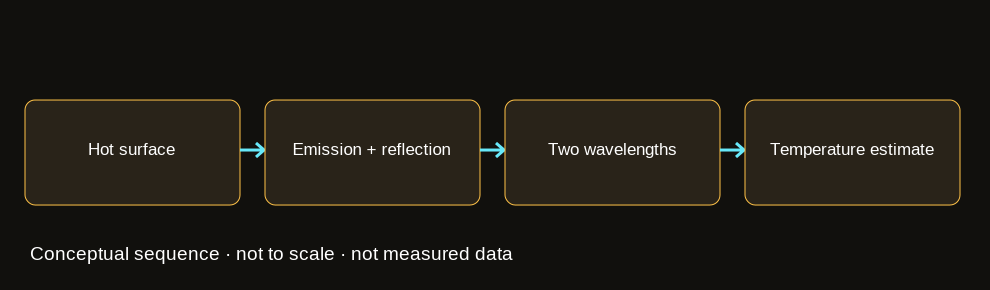
Bichromatic pyroreflectometry combines emitted-radiation and reflection measurements at two wavelengths. Active reflectivity measurements provide complementary information to estimate temperature and reduce sensitivity to surface properties within the model assumptions. [1]
Two colours do not remove every uncertainty
Channels require calibration, alignment control and a reflection model. Bidirectional reflectivity alone is not emissivity. The inferred temperature must be considered with its assumptions, limitations and measurement uncertainty.
From the laboratory to ThermoRef
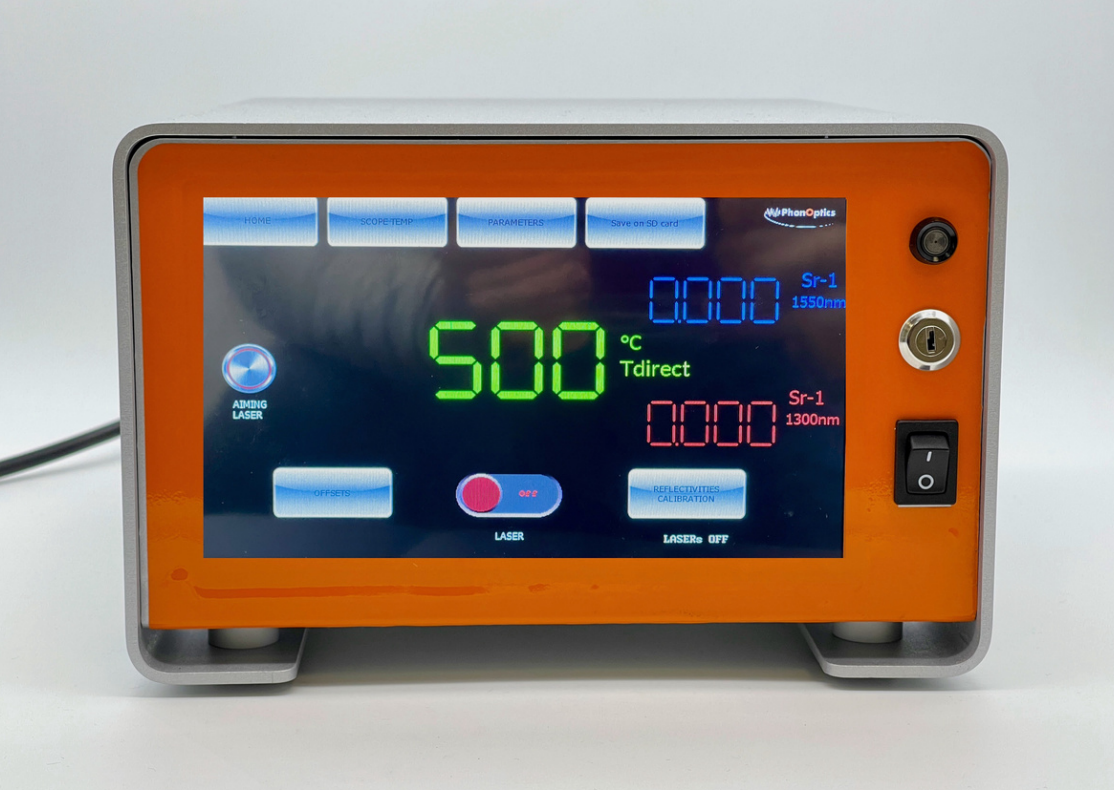
My Pprime work concerns optical-head development, calibration and uncertainty. Phonoptics markets ThermoRef. Its April 2022 preliminary brochure lists 500–1,500 °C and 1.3/1.5 µm channels; these are dated specifications, not guarantees for every current version. [2, 3]