Quandela develops quantum computers using individual photons. Semiconductor quantum dots prepare them; programmable optical circuits manipulate them. To understand this approach, follow a photon from emission to detection. [1,2]
1. A quantum dot inside a cavity
A quantum dot confines charge carriers within a nanoscale volume with discrete energy levels. A laser pulse prepares an excitation; radiative recombination can produce a photon. The micropillar cavity favors emission into a collectable mode, notably through the Purcell effect. “On demand” does not mean 100% collection efficiency. [1]
2. Synchronize photons and encode a qubit
In Ascella, a demultiplexer routes successively emitted photons into several paths; optical delays bring them to the chip together. One encoding uses two modes: |0⟩ = |1,0⟩ and |1⟩ = |0,1⟩. The qubit is a superposition of paths for one photon, rather than the overall presence or absence of light. [2,3]
3. Compute through interference
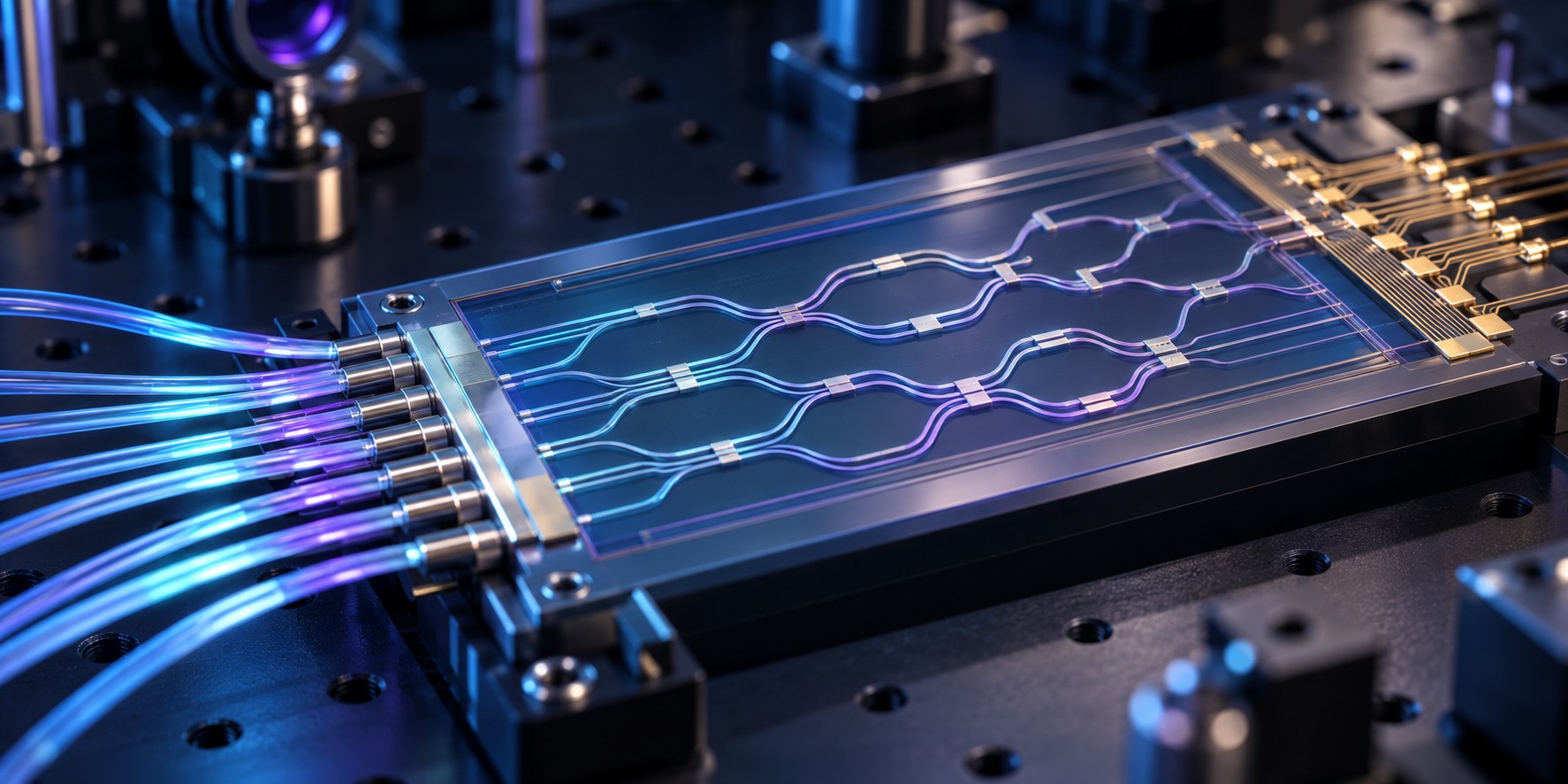
Beam splitters and phase shifters control probability amplitudes across modes. Indistinguishable photons can produce multiphoton interference. Linear optics enables single-qubit rotations; entangling operations require protocols involving measurements, additional resources or postselection. A universal mode interferometer is therefore not, by itself, a universal fault-tolerant computer. [3]
From emitted photon to computation result
- EmitLaser → quantum dot in cavity
- SynchronizeDemultiplexer + optical delays
- InterfereProgrammable couplers and phase shifters
- DetectOutput counts and coincidences
↶ Repeat the circuit to estimate output probabilities
Three distinct source metrics: brightness, single-photon purity and indistinguishability.
4. Detect and reconstruct statistics
Detectors record output photons and electronics identify coincidences. Repeated runs provide an outcome distribution. The Ascella demonstration published in 2024 combines six photons and twelve modes. Its source and superconducting detectors require cryogenic cooling: “photonic” does not mean the entire system operates at room temperature. [2,3]
5. Toward a hybrid spin–photon architecture
With SPOQC, Quandela targets an architecture combining spins and photons for larger-scale operations and error correction. This research direction is distinct from current photonic demonstrations. Reducing losses, preserving indistinguishability, stabilizing phases and producing high-quality entangled states remain central challenges. [1,4]