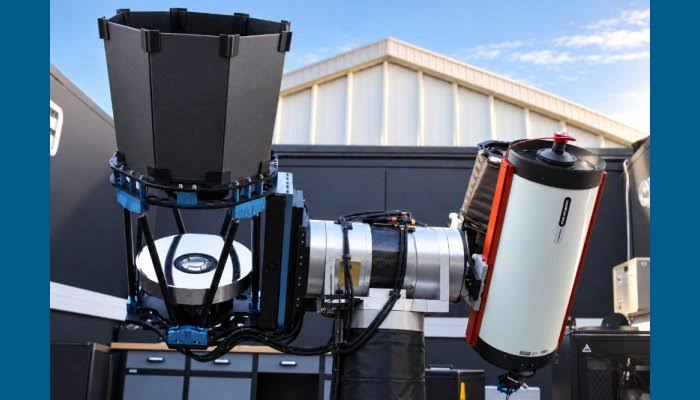
This article explains the RC principle. The photograph illustrates Edgar CASTA’s 500 mm telescope project; it does not establish that this instrument uses an RC prescription. Other Cassegrain-family designs, including corrected Dall–Kirkham, use different surfaces and corrections.
1. Collecting light and forming an image
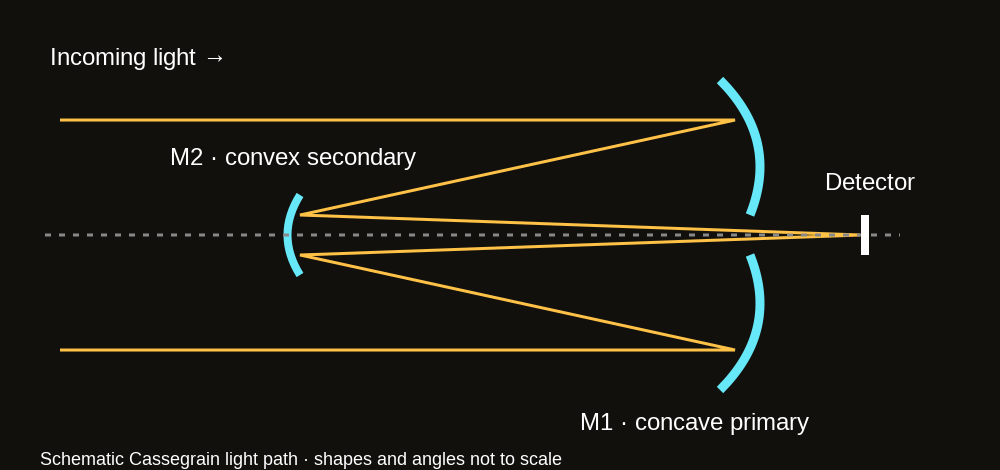
A telescope collects light over its aperture and forms an image on a detector. In the Cassegrain family, the concave primary sends light towards a convex secondary, which returns it through the central opening of the primary to a focus behind it. The folded path allows a long effective focal length in a shorter tube. [1]
2. What makes the RC design different?
A Ritchey–Chrétien uses two hyperbolic mirrors. Their optical prescription corrects spherical aberration and third-order coma. Astigmatism and field curvature remain: a flat, wide detector may need additional correction. Mirror spacing and alignment are important. RC is a particular optical design, not a synonym for every two-mirror telescope. [1]
3. Why build larger telescopes?
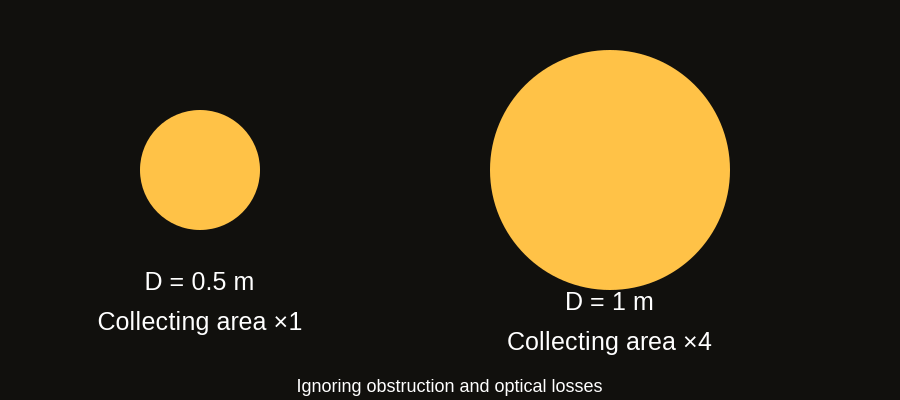
The geometric collecting area is A = πD²/4. Increasing diameter from 0.5 m to 1 m gives four times the area before obstruction and losses. A larger aperture gathers more photons from a point source under comparable conditions. The actual detection gain also depends on background, throughput, exposure and detector noise. [2]
4. Larger diameter also means finer detail
For an ideal unobstructed circular aperture, the Rayleigh criterion is θ ≈ 1.22 λ/D in radians. At 550 nm, this gives about 0.28 arcsec for 0.5 m and 0.14 arcsec for 1 m. These are calculated ideal values, not measured performance of the illustrated telescope; a central obstruction changes the diffraction pattern. [2]
5. Diameter is not enough
Atmospheric turbulence can dominate image quality. Adaptive optics corrects rapid wavefront distortions, whereas active optics compensates slower shape errors. A larger mirror also increases the demands on support, thermal control, alignment and tracking. More aperture does not simply mean more magnification. [3]