Choosing a laser for the intended measurement
Power alone is not enough to choose a laser source. Wavelength, stability, noise, linewidth and beam quality must suit the experiment. A source designed to excite fluorescence has different constraints from one intended for a measurement sensitive to frequency fluctuations. Two laser projects may therefore use very different benches and validation criteria.
244 nm UV laser: frequency conversion
At Oxxius, I worked on developing a 244 nm UV source for fluorescence spectroscopy. The project used frequency doubling in a BBO crystal: 488 nm light generates a component at 244 nm. Optical architecture, focusing and alignment require experimental investigation. Characterization included power and spectrum measurements, with simulations and testing to identify improvements.
532 nm Brillouin laser: noise characterization
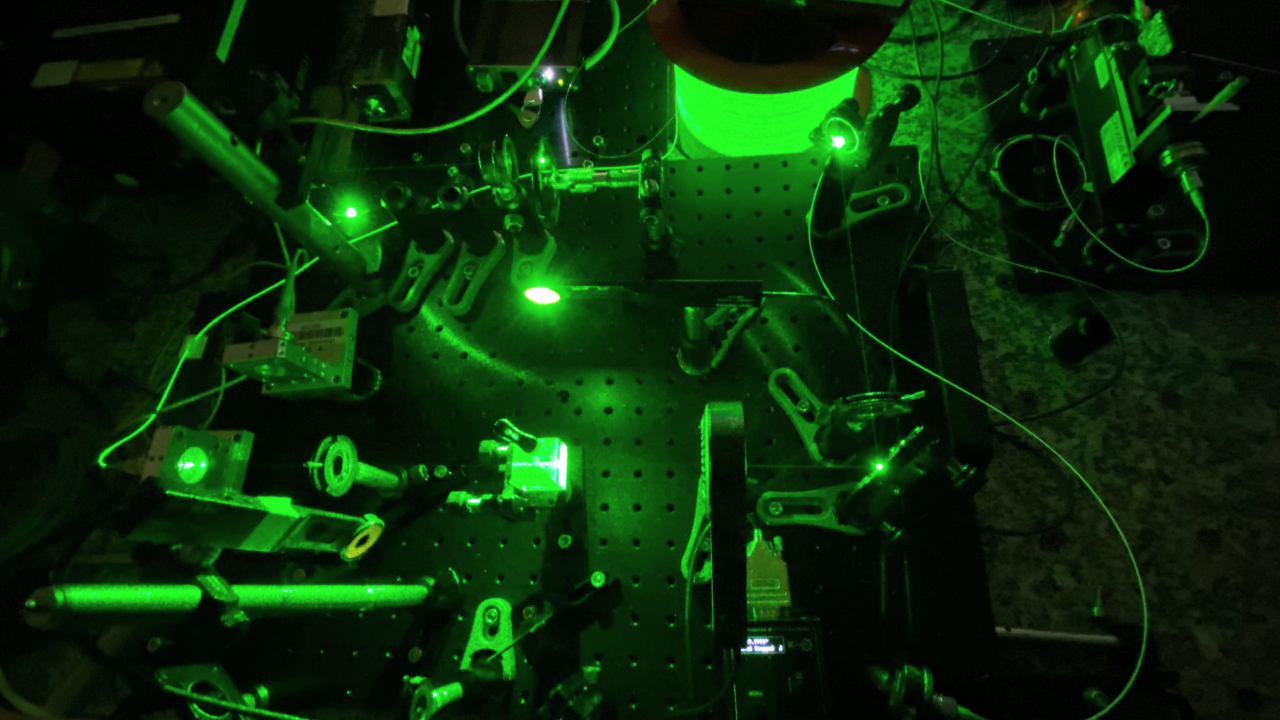
At Institut FOTON, the Brillouin project used a fibre resonator to develop a low-noise visible source for quantum technologies. My contributions included bench assembly, optical injection, power control and measurement automation in Python and MATLAB. The publication ‘Hz-level intrinsic linewidth Brillouin fiber laser in the visible range’, which I coauthored, presents this research. A linewidth must always be interpreted in light of its definition and measurement method.
A shared method: instrument and compare
These two developments remain distinct. They share an R&D approach: define the target performance, instrument the bench, test hypotheses and analyse results. Depending on the objective, the focus may be power measurement, a spectrum, a beat note or frequency-noise analysis. Documenting settings and acquisition conditions makes it possible to compare tests and identify real progress.
See the 244 nm UV laser project
See the separate 532 nm Brillouin laser project
Sources and references
- Optics Express — Brillouin publication and experimental diagram
- Oxxius — Lasers for measurement and metrology