What is a photonic integrated circuit?
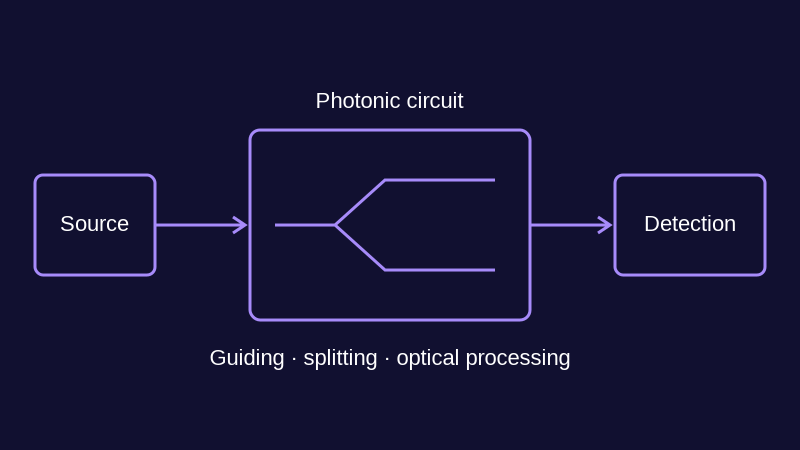
A photonic integrated circuit, or PIC, combines several optical functions on a chip. Waveguides carry light between elements that can split, filter or modulate it. Depending on materials and processes, some active functions are integrated or combined with external components. The principle is to create a compact optical assembly with optical interfaces and often electrical connections.
Applications beyond telecommunications
The EPoSS–Photonics21 white paper describes applications in communications, industrial sensors, healthcare and some quantum technologies. Miniaturization can make it easier to integrate an optical function into equipment. It does not, by itself, guarantee better performance of the complete system: that depends on the application and interfaces. A sensor and a communication module are not necessarily optimized against the same criteria.
Why coupling and packaging matter
Getting light into and out of the chip and maintaining connections are development challenges. Packaging here means assembling and enclosing the device to meet optical, electrical, mechanical and thermal constraints. Testing and characterization are part of this chain. A promising on-chip function must still operate reliably in its intended environment.
An experimental instrumentation perspective
To prepare a test, I would start with practical questions: what quantity must be measured, what power reaches the detector and which settings must be stabilized? A protocol must distinguish the effect of the component from that of the setup. This perspective builds on my skills in optical benches, electronics and automated acquisition. This article is part of my technology watch; the projects shown on this site concern lasers, metrology and optronic systems and do not claim PIC fabrication experience.