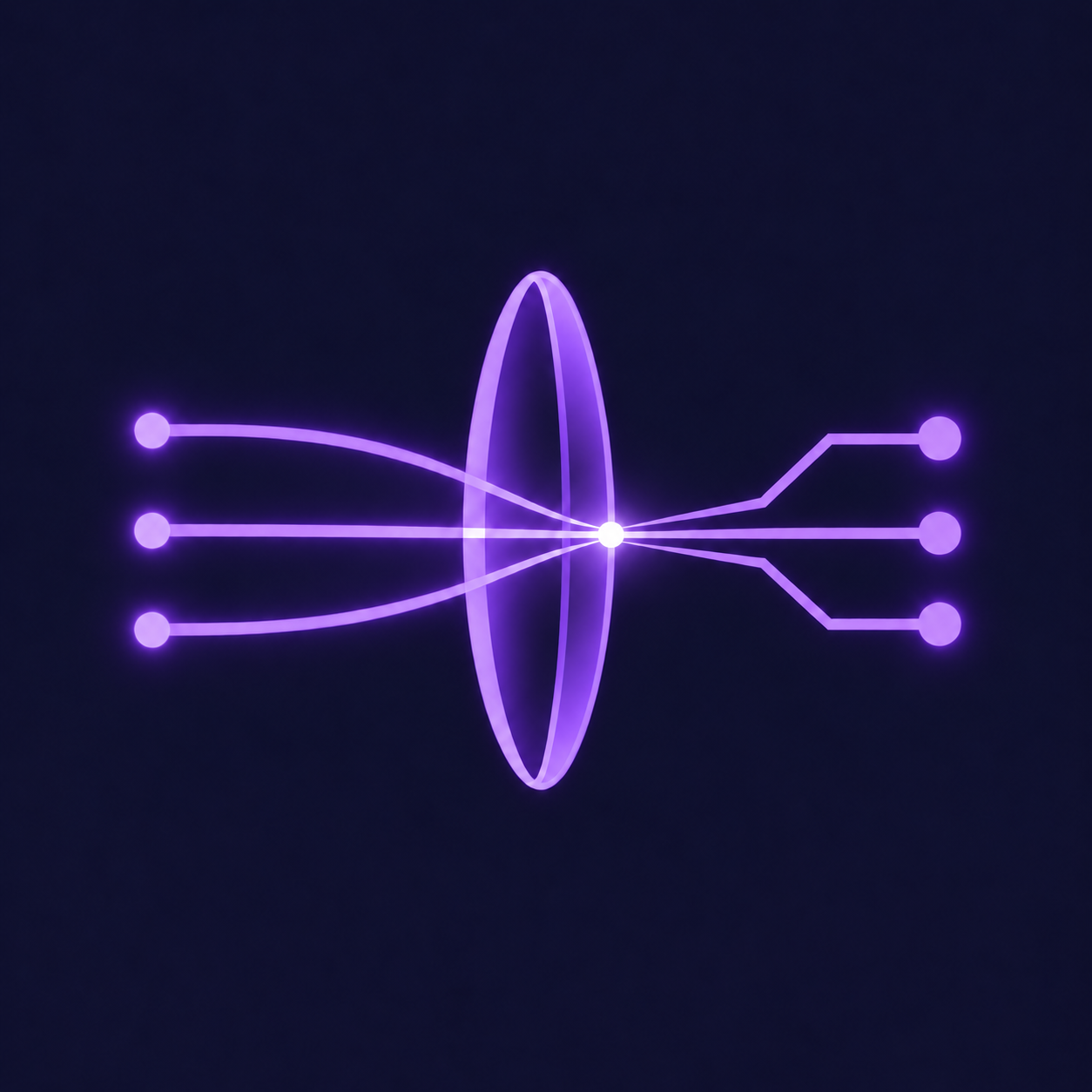
Three complementary fields
Optics studies light, its propagation and its interactions with materials. It informs lens selection, telescope alignment and image formation. Photonics covers technologies that generate, guide, modulate and detect light. Optronics combines optical and electronic functions in a practical system for observing, measuring, detecting or controlling. These fields overlap; their boundaries are not strict.
From an optical sensor to useful information
In a measurement chain, optics collect or transform light. A photodetector or camera then converts the light signal into an electrical signal. Electronics condition this signal, and software extracts information such as position, distance, temperature or intensity. Performance depends on the entire chain. A good camera does not automatically compensate for poor alignment, saturation or unsuitable calibration.
What are optronic systems used for?
Industrial vision, space surveillance and scientific instrumentation rely on these complementary skills. A surveillance telescope must combine image quality, motion control and data acquisition. A stereo vision system combines two observations and processing to estimate depth. User requirements determine the choices: range, accuracy, speed, environment and size.
The role of an optronics R&D engineer
Developing an instrument means translating requirements into specifications, building a prototype and verifying performance through testing. Problem solving often happens at the interfaces between optics, electronics and software. My R&D experience illustrates this approach, including telescope control electronics at Aldoria and validation of a vision-based obstacle detector at ARCYS. Based in the Paris region, I am interested in developing optical systems that address practical needs.